
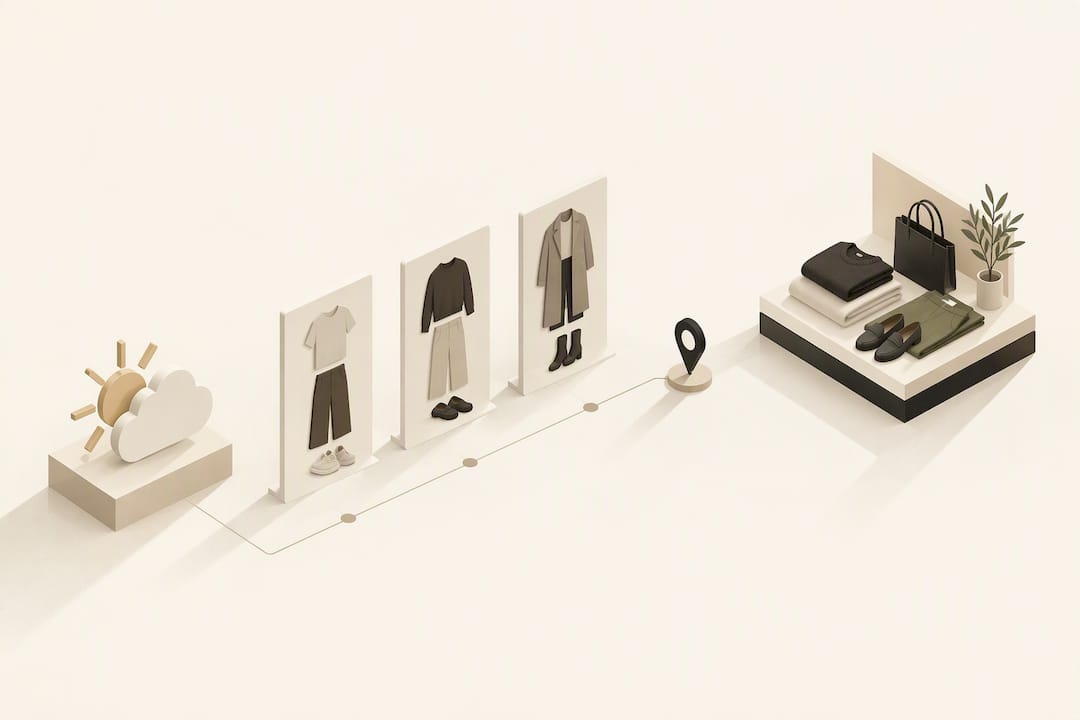
If it's in the 50s with a chance of rain and your day calls for smart-casual, wear a fitted long-sleeve shirt, straight-leg chinos, and leather sneakers, with a packable rain shell tied around your bag. Swap the shirt for a breathable tee if the sun breaks through. If you would rather skip the guesswork entirely, an app like Otherlook can pull your closet and the forecast together and hand you this answer in seconds.
TL;DR:
- Choosing outfits based on weather should prioritize rain, wind, and activity level, with waterproof and windproof layers supplementing the base clothing.
- The 3-3-3 capsule approach simplifies wardrobe choices, using nine versatile pieces in neutral colors to reduce decision fatigue.
- Small, reversible adjustments like rolling sleeves or unzipping jackets significantly improve comfort over adding more layers or more clothes.
- Pre-planning outfit swaps for heat or rain protection enhances readiness, preventing improvisation in worsening weather conditions.
- Digital wardrobe tools like Otherlook can generate personalized daily outfits, saving time by aligning clothes with weather and occasion automatically.
Table of Contents
- The 5-Minute Outfit Checklist: Weather, Occasion, Done
- Layering and Microclimate: The Adjustments That Actually Control Comfort
- The 3-3-3 Capsule Shortcut: Fewer Pieces, Less Decision Fatigue
- Weather-to-Outfit Quick Reference by Temperature Band
- Where to Get Outfit Ideas Fast
- Author Note and Why This Advice Holds Up
- Dressing for Work, Casual Days, Formal Events, and the Outdoors
- What the Research Actually Supports, and What Gets Overhyped
- Let Otherlook Handle Tomorrow's Decision Too
- Sources
- FAQ
The 5-Minute Outfit Checklist: Weather, Occasion, Done
You don't need a mood board to get dressed well. You need five quick decisions, made in order, so each one narrows the next.
- Read the weather signals. Check the temperature band, then look specifically for rain probability and wind speed, not just the "feels like" number. Wind above 15 mph cuts through light layers fast, even when the thermometer looks mild.
- Set your formality baseline. Decide in one word: casual, smart-casual, or dressy. Everything else in the checklist filters through that one choice.
- Pick one top, one bottom, one pair of shoes. Choose all three at once, matched to both the temperature band and the formality word you just picked. This is the step people overthink; treat it as multiple choice, not open-ended.
- Add one outer layer or accessory. A packable shell, a folding umbrella, or a scarf covers most surprise weather without changing the outfit underneath.
- Plan your swap before you need it. Decide now what you'll do if you overheat (roll sleeves, unzip, remove the layer) or if rain starts (shell goes on, bag gets covered). Deciding in advance means you're not improvising outside in a downpour.
Five steps, in that order, gets a workable outfit locked in well under five minutes for most people. The order matters more than any individual choice. Weather first, formality second, garments third. Skip a step and you end up circling back to the closet twice.
Layering and Microclimate: The Adjustments That Actually Control Comfort
Layering isn't just stacking clothes. It's building a system where each layer has one job. The base layer sits against your skin and manages moisture, think a merino or synthetic tee, not cotton. The mid layer insulates, a fleece pullover or a light sweater. The outer layer blocks wind and rain, a shell or a structured jacket. REI's layering guidance frames it exactly this way: pack each layer with a distinct role so you can add or drop pieces as conditions shift.
What most people miss is the air gap between skin and fabric, called the microclimate. Research on clothing thermophysiological comfort finds this air layer is often the dominant factor in how comfortable you actually feel, more than the total number of layers you're wearing. That's why small, reversible moves work so well:
- Roll your sleeves to vent heat without removing a layer.
- Unzip a jacket a few inches instead of taking it off entirely.
- Swap shoes if your feet are the only thing overheating.
- Stash a packable shell in your bag rather than committing to a heavier coat all day.
A study measuring clothing microclimate temperatures found that upper-layer count and inner-layer temperature predict overall insulation better than anything happening below the waist, since people rarely change pants or skirts between seasons anyway. Favor synthetic wicking fabrics for humid days or higher activity, and natural fibers like cotton or wool when you're mostly indoors or the air is dry.
Pro Tip: Keep roughly a 5 to 20 mm air gap between your skin and your outer layer for the best insulation. Wind strips that boundary layer away fast, so on gusty days, a windproof shell matters more than an extra sweater.

The 3-3-3 Capsule Shortcut: Fewer Pieces, Less Decision Fatigue
The 3-3-3 rule works with three tops, three bottoms, and three pairs of shoes chosen to mix freely. Nine pieces, dozens of combinations, and a decision you make once a week instead of every morning.
Six archetypes cover most weeks:
- Button-down shirt, dark jeans, leather sneakers, for casual Fridays and coffee runs.
- Fitted tee, chinos, loafers, for smart-casual client meetings.
- Sweater, tailored trousers, ankle boots, for cooler office days.
- Blazer over a tee, dark denim, minimal sneakers, for dinner plans.
- Breathable polo, shorts, trail shoes, for outdoor weekends.
- Structured jacket, midi skirt or trousers, block heels, for anything dressier.
Anchor the capsule around one or two neutral colors, navy, black, or camel, so every top pairs with every bottom without a second thought. For seasonal shifts or travel, swap one archetype at a time rather than rebuilding the whole set. A trip to somewhere colder just means trading the polo-and-shorts combo for the sweater option.
Weather-to-Outfit Quick Reference by Temperature Band
Match the fabric to the number on the thermometer, then adjust for rain, wind, and how hard you're actually moving.
Rain changes the math regardless of temperature. Add a packable shell and waterproof shoes, and pick quick-dry fabric over anything that holds water, like heavy cotton denim. Wind does the same thing to warmth that rain does to dryness, so The North Face's layering guide recommends prioritizing a windproof outer shell over adding another insulating layer underneath. Activity level shifts everything one band warmer. If you're walking briskly or standing outside for an event, dress as if it's 5 to 10 degrees cooler than the actual forecast, since your body generates its own heat once you're moving.
Where to Get Outfit Ideas Fast
Different tools solve different problems, and picking the wrong one wastes the five minutes you were trying to save. Weather-based outfit pickers solve speed: you get one suggestion for right now, not twenty options to sort through. Wardrobe digitizers like Otherlook solve personalization, since they suggest combinations from clothes you actually own instead of generic stock outfits, and features like virtual try-on let you preview a pairing before committing.
Style quizzes work when you're building a capsule from scratch and need a formality or color baseline. Interactive quiz approaches are useful here for exactly that reason. Pinterest boards and mood boards solve inspiration, not decisions, so treat them as a starting point rather than your daily source of truth. Reach for a mood board when you're planning a new capsule; reach for an app when you just need today's answer.
Author Note and Why This Advice Holds Up
This guide was compiled by Royston, drawing on textile science research and practical styling frameworks rather than personal opinion alone. The layering and microclimate advice throughout traces back to peer-reviewed and industry sources, including the finding that upper-layer adjustments matter more than lower-layer changes, and that the air gap between skin and fabric governs comfort more than raw layer count.
Otherlook builds on this same logic. It digitizes your wardrobe so outfit recommendations reflect your actual style, occasion, and the day's weather, then applies intelligent styling that learns from your past choices. Its Show It On Me feature previews outfit pairings virtually, so you see the combination before you commit to wearing it.
Dressing for Work, Casual Days, Formal Events, and the Outdoors
Occasion changes the rules faster than weather does, and mixing up the two is where most outfit decisions go wrong.
Work usually means smart-casual to business formal, depending on your office culture and whether clients are involved. A blazer instantly raises the formality of a plain shirt and trousers without adding bulk, which matters in offices that run warm indoors but cold outside. Keep one structured piece, a blazer or cardigan, on hand specifically for days when a meeting gets added to your calendar last minute.
Casual days give you the most room to prioritize comfort and weather over polish. This is where the capsule archetypes built around jeans, sneakers, and breathable tops earn their keep, since nobody's judging the outfit against a dress code.
Formal events reward planning ahead rather than fast decisions. Fabric choice carries more weight here: a wrinkle-resistant blend photographs and holds up better through a long evening than something that creases the moment you sit down. Check the venue, indoor events run warmer than outdoor ones regardless of the season.
Outdoor occasions, hikes, sports, yard work, need the layering system applied literally rather than for style. Base layer for moisture, mid layer for warmth, outer shell for wind and rain, exactly as covered earlier. Footwear matters more here than in any other category since wet or blistered feet ruin a day faster than a slightly wrong shirt ever could.

What the Research Actually Supports, and What Gets Overhyped
Most style advice treats formality and weather as separate problems, solved by separate wardrobes. The research doesn't back that split. The clearest finding across the textile science literature is that comfort comes from a handful of small, reversible adjustments, an unzipped collar, a rolled sleeve, a swapped shoe, not from owning more clothes or a bigger closet.
That's the part conventional advice gets backwards. Style content pushes trend pieces and seasonal hauls, while the actual lever for feeling good in an outfit is understanding your existing pieces well enough to adjust them fast. A 3-3-3 capsule beats a packed closet because fewer pieces, chosen deliberately, create more usable combinations than more pieces chosen randomly.
If you take one thing from this: stop optimizing for having more options and start optimizing for knowing your options cold. That's a solvable problem, and it's the one an app like Otherlook is actually built to solve, since it works from clothes you already own rather than pushing you toward new ones.
— Royston
Let Otherlook Handle Tomorrow's Decision Too
Otherlook is the direct alternative to standing in front of your closet every morning. It digitizes what you already own, checks it against today's forecast and whatever's on your calendar, and hands you a finished outfit, then lets you preview it on a virtual avatar with Show It On Me before you get dressed.

That combination solves the exact problem this guide walks through by hand:
- Cuts the daily decision down to seconds instead of five minutes.
- Uses clothes you already own, so it works against unnecessary purchases rather than encouraging them.
- Lets you preview a pairing with Show It On Me before committing to it.
- Learns your style over time instead of repeating the same generic suggestions.
The Free plan gets your wardrobe digitized and basic recommendations running at no cost. Pro runs $7.99 a month or $79.99 a year, and Max runs $14.99 a month or $149.99 a year for expanded capacity and more AI-styled outfit generations. Start by digitizing a shelf of your closet at Otherlook and see what it suggests for tomorrow.
Sources
- Clothing microclimate temperature and clothing insulation study (PMC article)
- Clothing thermophysiological comfort: a textile science perspective
- REI — Layering basics
- Explainer on the 3-3-3 rule
FAQ
What's the best outfit to wear today?
The best outfit matches today's temperature band and precipitation to your occasion's formality level, then adds one adjustable layer for surprises. Run the 5-minute checklist above, weather first, formality second, garments third, and you'll land on a workable answer without overthinking it.
What is the 3-3-3 rule for clothes?
The 3-3-3 rule is a capsule method built from three tops, three bottoms, and three pairs of shoes chosen to mix freely with each other. Anchoring the pieces around one or two neutral colors makes nearly every combination wearable, which is what cuts down daily decision fatigue.
How can an outfit make you look leaner?
Fit matters more than color here: garments that skim rather than cling or bag create a cleaner line, and a single vertical element, like a monochrome outfit or an open jacket worn straight, draws the eye up and down instead of across. Avoid boxy layering that adds visual bulk without adding warmth.
What is appropriate clothing for today?
Appropriate clothing balances the day's weather band against your occasion's formality baseline, work, casual, formal, or outdoor. Check the temperature and rain forecast first, then pick one top, one bottom, and shoes that satisfy both filters at once, adding a packable shell or umbrella if conditions look unstable.
Can an app really pick my outfit for me?
Yes. Tools like Otherlook digitize your existing wardrobe and combine it with the day's forecast and your calendar to suggest a specific outfit, then let you preview it virtually with Show It On Me before you commit. It works from clothes you already own, which sets it apart from general style quizzes or mood boards.