

The best airport outfit pairs a soft, neutral base layer with a structured stretch bottom, slip-on supportive shoes, and one oversized scarf or wrap that doubles as a blanket, pillow, and warmth. If your flight runs four hours or longer and you're at increased risk for blood clots, add graduated compression socks before boarding. Everything else — jewelry, jacket choice, shoe style — is customization on top of that base, and a tool like a digital wardrobe app can help you build it from clothes you already own.
TL;DR:
- Compression socks are highly recommended for flights over six hours, especially for travelers at risk of blood clots, to promote circulation and reduce swelling.
- Merino wool and Tencel fabrics outperform cotton and linen in cabin environments by regulating temperature, resisting odors, and drying quickly, making them ideal for long flights.
- Dressing in layers with a moisture-wicking base, a packable mid-layer, and an outer layer allows quick adaptation to changing cabin temperatures and humidity levels.
- Slip-on shoes with removable insoles facilitate quick security checks and accommodate swelling during long flights, enhancing comfort and foot health.
- Keeping a seat-pocket kit with essentials like compression socks, moisturizer, hand sanitizer, and a scarf ensures comfort, hygiene, and convenience during travel.
Table of Contents
- Six Airport Outfit Formulas You Can Copy Today
- Layering, Fabrics, and Temperature Control
- Shoes, Socks, and Foot Health on Flights
- Packing, Carry-On Strategy, and Your Seat-Pocket Kit
- Matching Your Outfit to Flight Length and Arrival Plans
- Plan Airport Outfits From What You Already Own
- Considerations for Cultural Sensitivity and Airport Dress Codes
- Outfit Choices Based on Travel Season and Climate at Destination
- Accessories That Make Airport Travel More Comfortable
- Wrinkle-Resistant and Easy-Care Fabrics Worth Packing
- A Travel Wardrobe Habit Worth Stealing
- Plan Your Next Airport Outfit From Your Own Closet
- Sources
- FAQ
Six Airport Outfit Formulas You Can Copy Today
You don't need a shopping trip to dress well for a flight. Most of these formulas work with pieces already hanging in your closet, just recombined with travel in mind.
- The polished travel uniform. A white tee, black tailored pants with stretch, a bomber jacket or unstructured blazer, and slip-on sneakers. Frequent flyers have leaned on some version of this combination for years because it reads put together at the gate and still survives six hours of sitting. Condé Nast Traveler's reporting on frequent-traveler habits points to this exact formula as the one seasoned travelers return to again and again. Swap the tee for a fitted knit and you've got a dressier version for a same-day meeting.
- The matching loungewear set. A jogger and hoodie or cardigan set in a solid color reads intentional in a way that mismatched sweats never do. Throw a longer structured coat over it at security and you avoid the "just rolled out of bed" look while keeping the elastic waistband comfort.
- Technical trousers with a merino base layer. Hiking-style or travel-specific trousers with stretch paneling paired with a merino tee or long-sleeve resist wrinkles and regulate temperature far better than standard cotton or a suit.
- Stretch denim, done carefully. Rigid denim is one of the worst choices for a flight because it won't give as you swell or sit for hours. Stretch or jegging-style denim, on the other hand, moves with you and still looks like real pants.
- The dress-forward option. A simple knit dress with a cardigan and loafers works well if you're landing straight into a meeting or dinner. Knit fabric won't crease the way woven fabric does, and you skip re-dressing at your destination entirely.
- The elastic-waist, longer-tunic option. For pregnant travelers or anyone who wants zero pressure at the midsection, an elastic-waist pant, a longer tunic top, and a supportive slip-on shoe covers comfort without looking like sleepwear.
Layering, Fabrics, and Temperature Control
Airport terminals run warm, jet bridges run stuffy, and the cabin itself sits cooler and drier than almost anywhere else you'll be that day. Cabin pressure typically mimics an altitude of 6,000 to 8,000 feet, with humidity dropping to around 10 to 20 percent. That combination dries out your skin and encourages swelling, which is exactly why fabric choice matters more on a plane than almost anywhere else you'll wear clothes.
Merino wool and Tencel outperform cotton for this environment. Merino regulates temperature across a wide range and resists odor over a long travel day, while Tencel dries fast and drapes without clinging, according to travel-styling guidance on long-haul dressing. Cotton, by contrast, holds moisture and wrinkles the second you sit down for three hours.
Think in three layers, dressed in the order you'll need to remove them:
- A moisture-wicking base layer in merino or Tencel against your skin.
- A packable mid-layer, like a long cardigan or lightweight vest, for temperature swings between the gate and the cabin.
- An outer layer, such as a packable down jacket, that you can shed one-handed while still seated.
Pro Tip: Pack your outer layer and the item you'll remove first at the top of your bag, not buried underneath everything else. You'll need to shed layers faster than you think once boarding starts.
Avoid anything with a rigid waistband. Tight jeans, structured trousers with no give, and firm elastic all restrict circulation exactly when your body is already retaining fluid from cabin pressure. Stretch waistbands or a drawstring solve this without sacrificing shape.
Shoes, Socks, and Foot Health on Flights
Slip-on sneakers or loafers with removable insoles are the smartest footwear choice for flying. You clear security faster without laces to unthread, and removable insoles let you loosen the fit if your feet swell mid-flight, a common issue on longer routes.
The health case for the right footwear and hosiery is stronger than most travelers realize. Flights lasting four hours or more roughly double the risk of venous thromboembolism, according to CDC guidance on deep vein thrombosis and air travel. For travelers at elevated risk, that guidance recommends graduated compression socks at 15 to 30 mmHg, along with frequent movement and calf exercises. If you're not at elevated risk but just want comfort on a long sector, a lighter 15 to 20 mmHg sock still helps with end-of-flight swelling.
Flights of 4+ hours roughly double VTE risk for some travelers, per CDC guidance, making below-the-knee compression, movement, and calf exercises worth building into your routine on longer sectors.
A few habits make a real difference:
- Break shoes in before travel day. Never wear a brand new pair on a long flight.
- Keep socks on for the whole flight, both for hygiene and for comfort during swelling.
- Put shoes back on before descent starts, since your feet are at their most swollen right before landing.
- Choose removable insoles so you can adjust fit mid-flight without changing shoes.
Packing, Carry-On Strategy, and Your Seat-Pocket Kit
What you keep within arm's reach matters as much as what you're wearing. A well-stocked seat-pocket kit means you're not digging through an overhead bin at 35,000 feet.
Pack these items where you can reach them without standing up:
- Compression socks, if you're not already wearing them.
- An eye mask and a small neck pillow or rolled sweater for support.
- Lip balm, moisturizer, and eye drops for the dry cabin air.
- Hand sanitizer with at least 60% alcohol, along with earbuds and any medication you need on hand.
Good hand hygiene and avoiding contact with high-touch surfaces meaningfully cut infection risk in airports and cabins, per CDC air travel guidance, which is reason enough to keep sanitizer accessible rather than checked.
For the bag itself, stow your compressible outer layer where you can grab it fast, use your scarf as a blanket or pillow substitute, and slide shoes under the seat in front of you with insoles loosened. IATA's work on biometric processing and digital identity is gradually cutting down how often you'll need to hand over a passport at each checkpoint, but until that's universal, keep documents in one accessible pocket rather than buried in your bag.
Matching Your Outfit to Flight Length and Arrival Plans
Not every flight calls for the same outfit. A 90-minute hop and a 12-hour long-haul are different problems entirely.
- Short haul, under 3 hours. Go polished casual. Skip bulky layers and compression socks; the flight is too short for either to matter much.
- Medium haul, 3 to 6 hours. Prioritize stretch fabrics and add one mid-layer for temperature swings. Comfort-focused compression socks (15 to 20 mmHg) are a reasonable add here even without elevated risk.
- Long haul, 6 hours or more. Go full comfort mode: a matching set or technical trousers, compression socks if you're at elevated risk, layered warmth, and sleep accessories like an eye mask and travel pillow. If you land straight into a meeting, pack a wrinkle-resistant blazer or cardigan in your carry-on to throw on after landing.
Watch for three red flags regardless of flight length: rigid denim, any waistband that leaves a mark when you sit, and new shoes you haven't broken in. All three turn a manageable flight into an uncomfortable one.
Plan Airport Outfits From What You Already Own
Most travelers don't need new clothes for a flight. They need a faster way to see what they already have arranged into a workable outfit, which is exactly the gap OtherLook's digital closet is built to close.
Start by digitizing your core travel pieces and tagging them by function: base layer, mid layer, outer layer, shoes. Once those are logged, the app can surface ready-made airport formulas pulled straight from your own wardrobe instead of a generic lookbook. From there, build travel capsules organized by flight length, then preview combinations with the virtual "Show It On Me" feature before you ever pack a bag.
- Tag travel pieces by layer function so outfit suggestions stay relevant to flying, not just everyday wear.
- Build a separate capsule for short-haul, medium-haul, and long-haul trips.
- Preview pairings virtually before packing to catch mismatches early.
- Reuse the same capsule logic for the return trip instead of rebuilding it from scratch.
Considerations for Cultural Sensitivity and Airport Dress Codes
Airports are not neutral ground when it comes to dress. What passes for casual comfort at your home terminal can read as inappropriate or even disrespectful at your destination, and that gap catches a lot of otherwise well-prepared travelers off guard.
Some countries and airports enforce modesty expectations well beyond what's typical in the United States, particularly around bare shoulders, short hemlines, or visible undergarments in public spaces. This matters most the moment you land, not just at your final destination, since immigration and customs staff are your first in-person interaction with local norms. Landing in a more conservative region wearing gym shorts and a tank top can complicate an otherwise routine entry process, even when nothing about it is technically against the rules.
The safest approach is layering with intention rather than dressing for two different climates. Wear the more conservative layer, like a longer cardigan or a scarf that covers shoulders, on top of your comfortable travel base, and remove it only once you're through arrivals and clear on local norms. A scarf earns its place here twice over: it's a blanket on the plane and a shoulder cover the moment you land somewhere stricter than home.
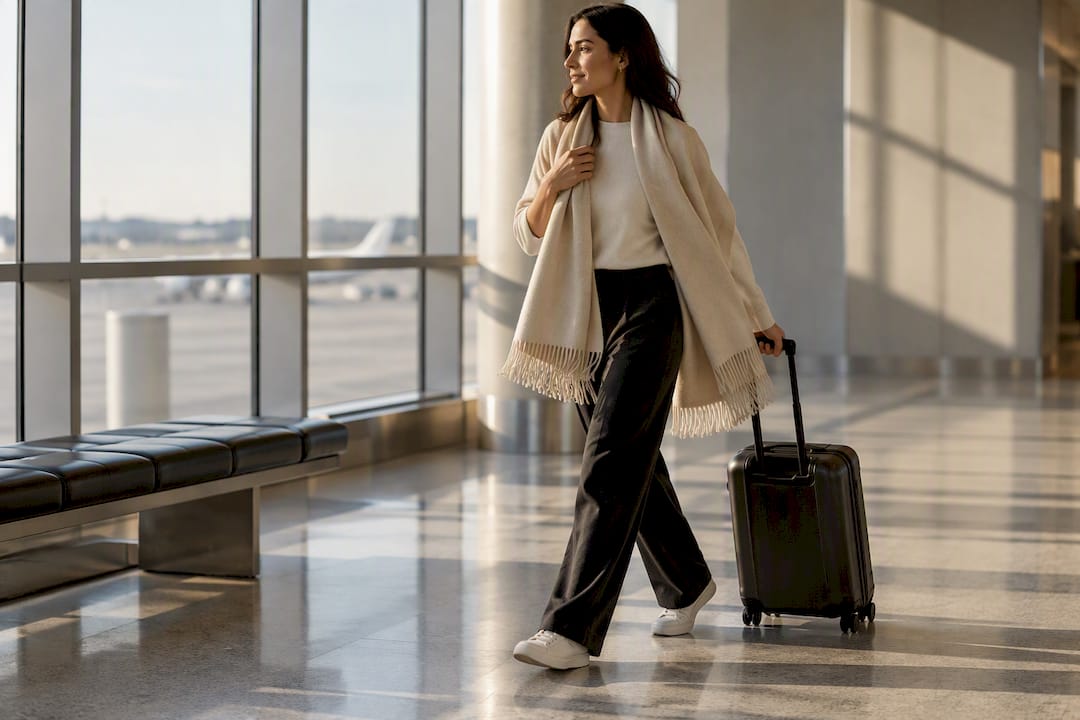
Religious sites near some airports and connecting hub cities also enforce specific dress requirements, so if your itinerary includes a layover with a city tour, packing one modest layer solves both problems at once. This isn't about erasing your personal style. It's about having one flexible piece ready so you're not scrambling in an airport bathroom to cover up before customs.
Outfit Choices Based on Travel Season and Climate at Destination
The trickiest airport outfit challenge isn't the flight, it's the mismatch between where you're leaving and where you're landing. Flying from a snowy departure city into a tropical arrival means dressing for two climates in one outfit, and the layering strategy from earlier in this article is exactly how you solve it.
In winter travel, build around a heavier outer layer you can shed entirely once you land somewhere warm. A wool coat or puffer jacket makes sense at departure, but it's dead weight the moment you touch down somewhere hot, so plan to stuff it into your carry-on rather than wear it through your destination airport. Underneath, keep your base and mid layers lightweight enough to stand alone once the outer layer comes off.
Summer travel flips the problem: you're comfortable at departure but cabins run cold regardless of season, since climate control keeps cruising altitude cabins chilly no matter what it's like on the tarmac. Pack a lightweight cardigan or scarf even for a July flight, because dressing for the ground temperature alone guarantees you'll be cold for hours in the air.
Shoulder-season trips, spring or fall, tend to be the easiest to plan for since temperature swings are usually smaller in both directions. The safest bet across all three scenarios is dressing for the coldest point in your journey, which is almost always the cabin itself, and packing anything warmer than that as a removable layer rather than wearing it outright.
Accessories That Make Airport Travel More Comfortable
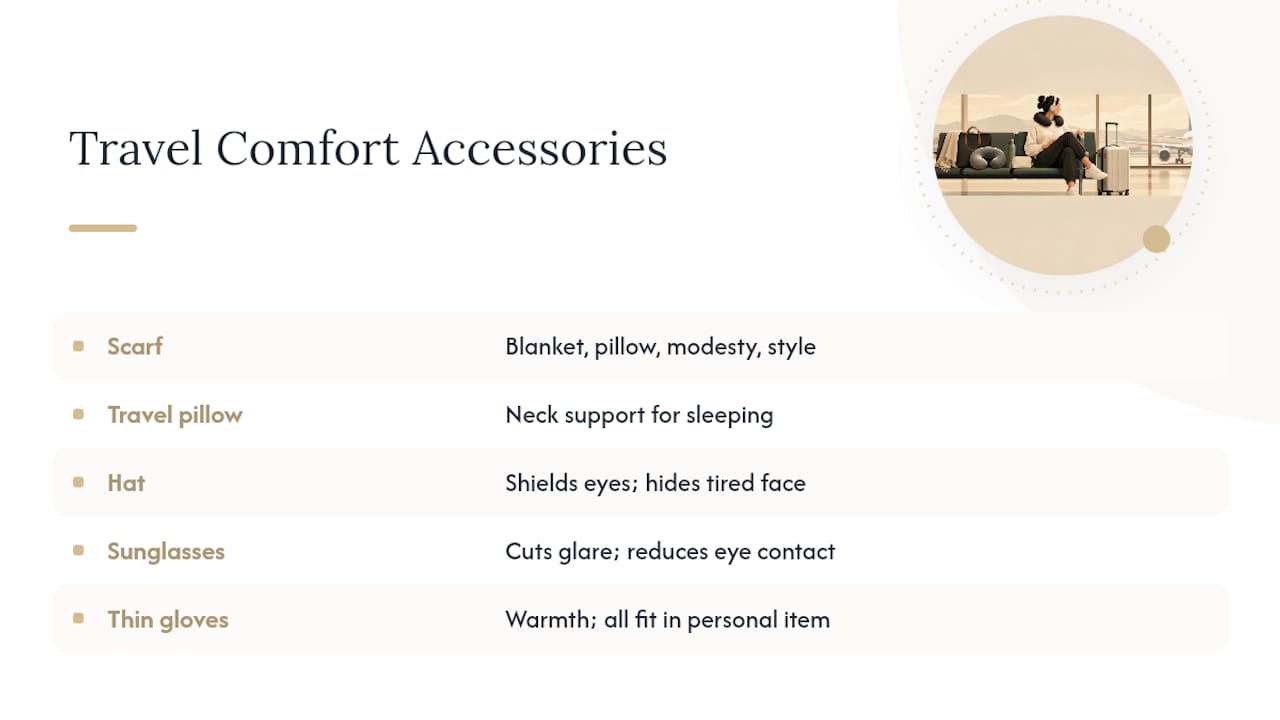
A few well-chosen accessories do more for airport comfort than an entirely new outfit. The scarf deserves top billing here: a large neutral scarf functions as a blanket, a makeshift pillow, a shoulder cover for modesty-sensitive destinations, and a style accent, all in one piece of fabric. It's arguably the single most versatile item you can pack for a flight, which is why frequent travelers rarely fly without one.
A structured travel pillow or an inflatable neck support helps on anything longer than a medium-haul flight, particularly if you're planning to sleep. Compression-style neck pillows that fold flat pack far better than the bulky horseshoe versions from a decade ago.
A hat, whether it's a soft baseball cap or a packable bucket hat, does double duty: it shields your eyes for napping and covers up when you land after a long red-eye without time to freshen up. Sunglasses serve the same purpose during daylight arrivals, cutting glare while also reducing how much eye contact you need to make when you'd rather not.
Fingerless gloves or a pair of thin cashmere gloves help on flights where cabin temperature runs unusually cold, especially near window seats. None of these accessories require checked luggage. They all fit inside a personal item, which is exactly where they're most useful anyway.
Wrinkle-Resistant and Easy-Care Fabrics Worth Packing
Fabric choice determines whether you look pulled together after eight hours of sitting or like you slept in your clothes, because some fibers hold a crease the moment you bend a knee.
Merino wool tops the list for travel because it resists wrinkles naturally, regulates temperature across warm terminals and cold cabins, and resists odor well enough to wear twice without washing. Tencel, a fiber derived from wood pulp, runs a close second: it drapes softly, dries quickly if you spill something, and doesn't wrinkle the way linen does, according to long-haul travel fabric guidance.
Ponte knit is another strong option, especially for pants and dresses. It has enough structure to look tailored but stretches and recovers like an athletic fabric, so it survives hours of sitting without bagging out. ITY jersey, common in travel-brand dresses and tops, behaves similarly and rolls into a bag without creasing.
Avoid linen and pure cotton for anything you're wearing for more than a couple of hours in transit. Both wrinkle almost on contact and cotton in particular holds onto moisture rather than wicking it away, which becomes uncomfortable fast in a dry cabin. Silk, while beautiful, wrinkles easily and shows sweat marks, making it a better choice for your destination than for the flight itself.
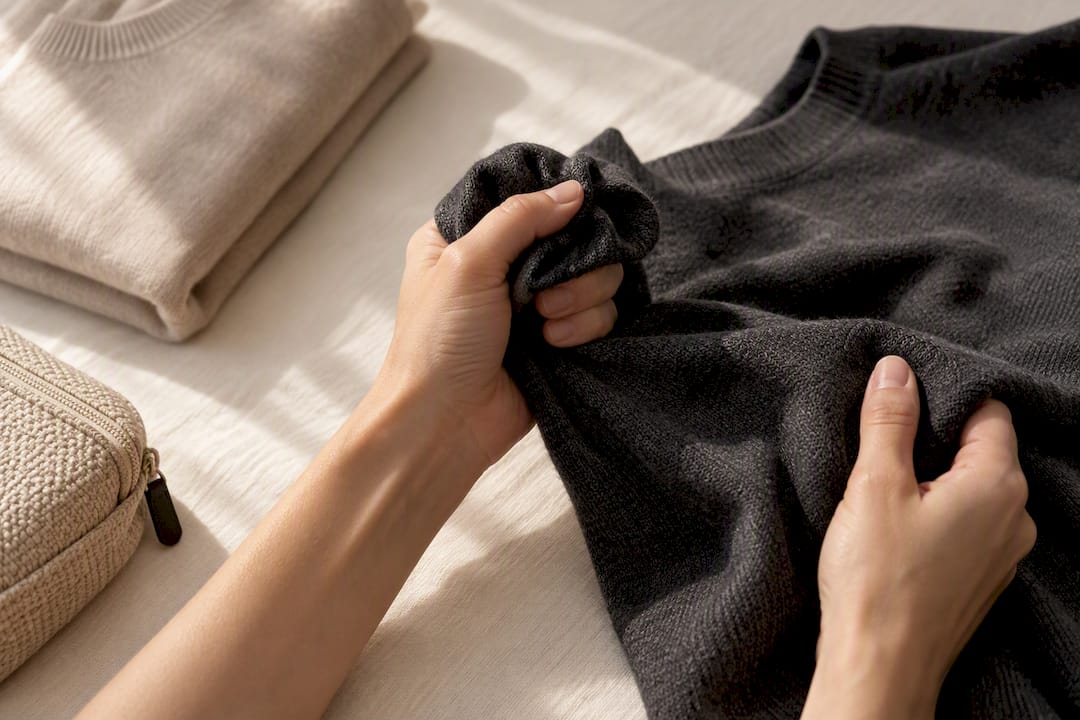
If you're unsure whether a piece will hold up, the crumple test works well: ball up a corner of the fabric in your fist for ten seconds and let go. Fabric that springs back mostly wrinkle-free is safe for travel. Fabric that stays creased is better left for your suitcase.
A Travel Wardrobe Habit Worth Stealing
If there's one habit worth adopting from this whole approach, it's putting compression socks on before boarding, not mid-flight. They're far easier to manage while you're standing at the gate than wedged into an economy seat, and the comfort benefit builds across the entire flight rather than kicking in late. Pair that habit with a scarf you never fly without, and most of the outfit decisions above take care of themselves.
— Royston
Plan Your Next Airport Outfit From Your Own Closet
Every formula in this article assumes you already own most of what you need, and that's the real problem most travelers run into: not a lack of clothes, but a lack of time to figure out which pieces actually work together before a 5 a.m. flight. OtherLook solves that by turning your existing wardrobe into a digital closet that suggests outfits based on your style, the occasion, and even the weather at your destination.

Build a dedicated travel capsule inside the app, tag your base, mid, and outer layers by function, then preview combinations with the "Show It On Me" virtual feature before you ever pack a bag. It's a faster way to pull together the exact layered, stretch-friendly, scarf-topped outfit this article recommends, using pieces you already own rather than a fresh shopping trip. OtherLook's free plan gets you started with digitizing your closet and generating outfit suggestions, and the Pro and Max tiers unlock more virtual previews and bulk digitization if you travel often enough to want it. Start by uploading a few travel staples and see what the app pairs together for your next flight.
Sources
- Deep Vein Thrombosis and Pulmonary Embolism | Yellow Book | CDC
- Physiological effects of cabin environment (PMC article)
- IATA press release on digital identity and contactless travel
This article is general information, not a substitute for advice from a qualified doctor. Consult a qualified healthcare professional about your own circumstances before acting on anything here.
FAQ
What's the best thing to wear to an airport?
The best airport outfit is a soft, breathable base layer like merino or Tencel, paired with stretch pants or a matching loungewear set, slip-on sneakers or loafers, and a large scarf you can use as a blanket or shoulder cover. This combination handles the cold, dry cabin air, which typically drops humidity to 10 to 20 percent, while still looking put together at security and baggage claim.
What is the 3-3-3 rule for outfits?
Definitions of the 3-3-3 rule vary depending on the source, and this article doesn't cover a specific version of it in detail. Generally, capsule-wardrobe frameworks with similar numbering suggest limiting an outfit or travel wardrobe to a small, mixable set of pieces, such as three tops, three bottoms, and three pairs of shoes, so everything pairs with everything else.
What should a 50-year-old woman wear to the airport?
There's no age-specific airport outfit, but comfort priorities shift toward elastic or drawstring waistbands, longer tunic tops, and supportive slip-on shoes with removable insoles. Layering with a cardigan or wrap over a merino or Tencel base covers both temperature swings and modesty needs across different airports and cultures.
What are you wearing to the airport?
A layered outfit built around a stretch base, a structured mid layer, slip-on shoes, and a scarf covers nearly every flight scenario, from a short domestic hop to a long-haul red-eye. Adjust for flight length: skip compression socks on flights under three hours, but add them before boarding on anything six hours or longer, especially if you're at elevated risk for blood clots.